Transforming Industrial Health & Safety
In today’s industrial landscape, prioritizing employee health, safety, and well-being is no longer optional—it is an absolute necessity. Sharing lessons learned from health and safety incidents, both within and beyond the organization, is a critical corporate responsibility. Fortunately, technologies like 3D visualization provide an effective tool for raising awareness and significantly improving worker safety. Traditional safety training methods often struggle to convey complex situations and potential hazards effectively. Two-dimensional diagrams and textual descriptions frequently fail to illustrate the real impact of dangerous scenarios. MVR’s 3D visualization, however, enables the creation of high-fidelity simulations of health and safety incidents. These immersive experiences allow audiences to see realistically what could happen, along with the crucial steps required to prevent such accidents.
Enhancing Employee Safety with 3D Visualization Technology
MVR adopts a collaborative approach, working closely with companies to develop customized industrial health and safety visualizations tailored to their specific needs. This personalized approach ensures that training resonates with employees and addresses the most critical safety concerns in their work environment. The power of 3D visualization goes beyond mere observation. Combined with immersive technologies like virtual reality, it enables truly interactive training experiences. Employees, contractors, and other stakeholders can actively engage in simulated scenarios, practice safe procedures, and experience the consequences of unsafe choices in a controlled environment. This interactive approach to safety training fosters a deeper understanding and retention of essential safety protocols.
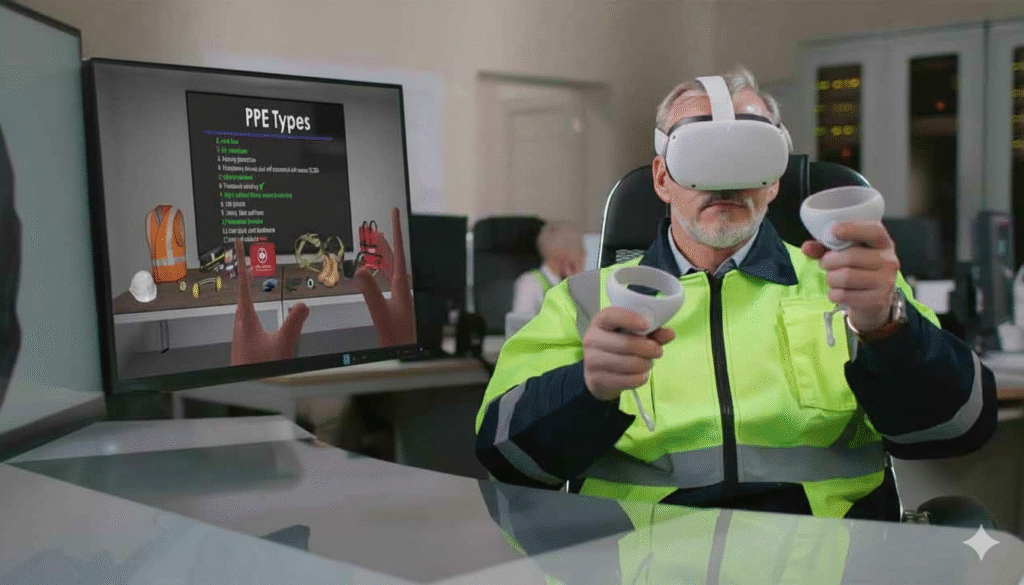
MVR holds a unique position that enables it to deliver exceptional industrial health and safety solutions. Our team combines extensive expertise in 3D animation with over two decades of experience in the industrial sector. This deep understanding allows us to create training materials that are visually engaging, technically accurate, and tailored to the challenges our clients face. Our commitment to excellence has earned the trust of industry leaders such as Teck Resources and Newmont Corporation. Through their partnership with MVR, these companies empower their employees with the knowledge and skills needed to make safe decisions every day. Investing in 3D visualization for health and safety training is an investment in the future of your workforce. Contact MVR today to discover how we can help create a safer and more productive work environment for everyone.
Initial Planning and Goal Setting
Define the purpose of the 3D visualization (e.g., training, risk assessment, emergency response).
Identify the scope and specific requirements.
Set objectives for the visualization, such as key hazards to highlight and safety protocols to demonstrate.
Data Collection and Analysis
Gather relevant data about the industrial site, including floor plans, machinery details, and operational processes.
Consult with safety experts and specialists to identify critical safety concerns.
Analyze incident reports and safety audits to pinpoint common issues and areas requiring focus.
Software and Tools Selection
Choose appropriate 3D modeling and visualization software (e.g., Autodesk Maya or Unreal Engine).
Determine if additional tools are needed for specific features (e.g., integrating Virtual Reality (VR) or Augmented Reality (AR)).
3D Modeling and Asset Creation
Create detailed 3D models of the industrial environment, including buildings, machinery, and safety equipment.
Ensure accuracy and dimensional fidelity to the real-world setting.
Develop 3D models of workers, rigged and ready for animation.
3D Animation and Simulation
Produce a detailed animated reenactment of the industrial incident, including characters and equipment.
Add high-quality details such as realistic lighting and textures to enhance realism and impact.
Simulate the real environment at the time of the incident, highlighting hazards, environmental conditions, and equipment status.
Review and Validation
Conduct thorough reviews to ensure the accuracy and functionality of the 3D visualization.
Validate the animation in collaboration with safety experts and company stakeholders to confirm that key objectives are met.
Refine and enhance the visualization based on feedback and observations.